
Gel Blaster Magazine Guide: Fix Feeding Issues & Jams
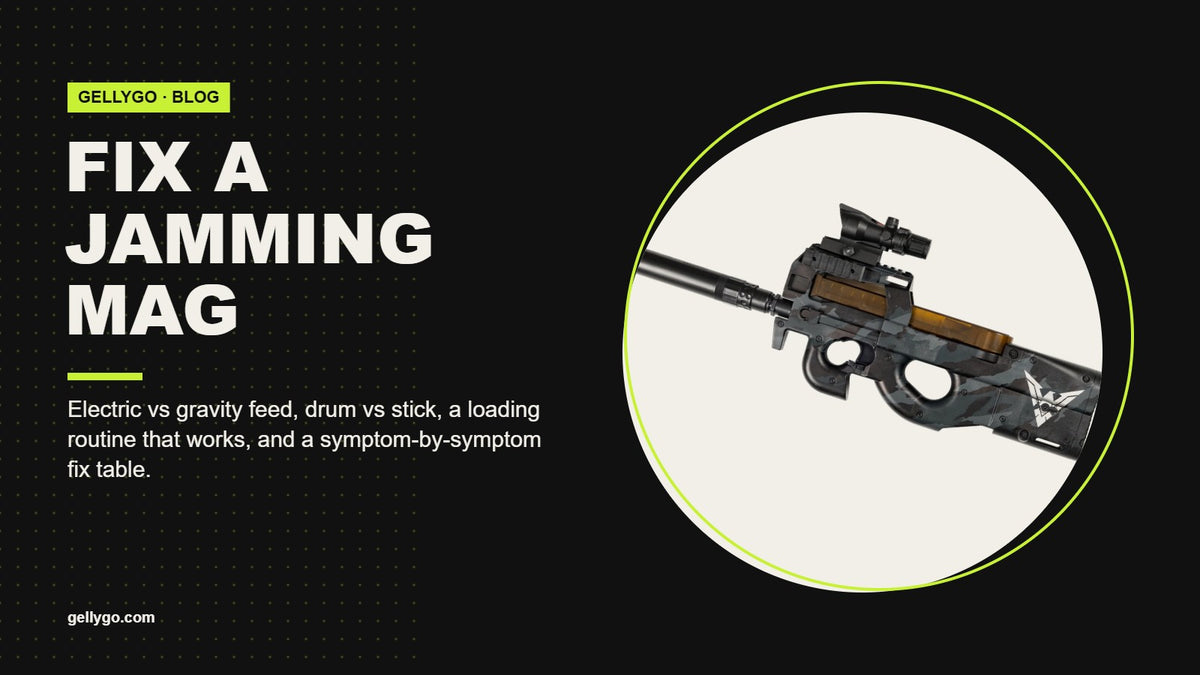
The blaster spins up, the gearbox cycles, and nothing leaves the barrel. Or it fires three, dry-fires two, then fires one. Most players blame the gearbox. Nine times out of ten the problem lives in the magazine, or in what you put in it. This guide covers how gel blaster magazines actually work, how to load them so they feed, and how to fix the specific feeding failures we see most often.
How a gel blaster magazine feeds
Every electric gel blaster magazine has to do the same job: push gel balls up a feed tube and hold one at the top so the tappet plate can shove it into the hop-up chamber on each cycle. There are two ways to do that.
- Gravity / spring-fed magazines. A spring-loaded follower or plain gravity keeps the column of gels pressed toward the feed lip. Simple, nothing to fail electrically, but they only work when the gels are uniform and the mag is held roughly upright.
- Electric (motorized) magazines. A small motor in the mag drives a cog or paddle wheel that actively pushes gels up the tube. It draws power through two metal contacts that touch terminals inside the mag well. Most rifle-style blasters and all the big drums use this design. The upside is reliable feeding on full-auto; the downside is three extra failure points: the contacts, the wire, and the motor.
Knowing which type you have tells you where to look first. If you have an electric mag, you can test it on its own: touch a 9V battery to the two mag terminals (polarity varies by model, so try both ways). If the wheel turns, the mag is alive and the problem is either the gels or the blaster's terminals. If nothing happens, the mag itself is the fault.
Drum vs stick magazine
| Feature | Stick mag | Drum mag |
|---|---|---|
| Capacity | Lower (varies by blaster) | Much higher |
| Weight on the blaster | Light, keeps a pistol or SMG balanced | Heavy when full, front-heavy on small blasters |
| Jam frequency | Low; short, straight feed path | Higher; longer internal path with more corners |
| Sensitivity to gel size | Moderate | High; oversized gels bridge and stall the wheel |
| Best for | Skirmish, semi-auto, sidearms, kids' blasters | Support role, full-auto suppressive fire, big group games |
Our honest take: a drum is fun for a support gunner in a big group game, but for most players two or three stick mags on a belt beat one drum. You reload more often, but you almost never stop to clear a jam mid-round.
Loading a magazine so it actually feeds
Most "broken" magazines were loaded wrong. Do it this way every time:
- Start with sized, drained gels. Fully hydrated, roughly uniform, and strained of standing water. Wet gels stick together and clump at the feed lip. If you are unsure your soak is right, read our gel ball soaking guide first; it fixes more feeding problems than any tool.
- Use one batch, one brand. Mixing leftover gels from different bags is the single most common cause of intermittent feeding. Different brands finish at slightly different sizes and hardness. A harder, consistent gel like our Hardest Frosted gel balls or Hardest Milky gel balls feeds far more predictably than a bargain mix.
- Fill through the correct port. Some mags load through a sliding door on top, some through the feed lip, and some need a speed loader bottle. Never pry the feed lip open to shove gels in; a bent lip is a dead mag.
- Leave headroom. Fill to about 90 percent. A packed-solid column gives the follower or wheel nothing to move against.
- Prime an electric mag. Many electric mags have a small prime button on the base. Hold it for a second or two until you see gels reach the top of the feed tube. Skipping this is why the first three trigger pulls are dry.
- Seat it until it clicks. A mag that sits one or two millimeters low will spin its motor but never line up with the feed opening. Push up, listen for the click, tug down once to confirm it is locked.
Diagnosing feed failures by symptom
| Symptom | Most likely cause | Fix |
|---|---|---|
| Motor spins, no gels exit, mag is full | Mag not seated, or gels not primed to the top | Reseat with a firm click, hold prime button, retest |
| Fires, dry-fires, fires (intermittent) | Mixed or oversized gels bridging in the tube | Dump the mag, load one uniform batch |
| Electric mag wheel does not turn in the blaster, but turns on a 9V | Dirty or flattened mag-well terminals, or a broken wire to them | Clean contacts with a dry cloth, gently bend spring terminals outward; broken wire needs a shop |
| Wheel does not turn even on a 9V | Dead mag motor or seized wheel from dried gel residue | Open the mag, clear residue, free the wheel; replace the mag if the motor is dead |
| Gels come out shattered or as mist | Gels too soft or old, or split gels stuck at the feed lip | Fresh batch of harder gels; inspect and clear the lip |
| Feeds fine upright, dies when you tilt or go prone | Gravity-fed mag with gels too small to hold a column | Soak longer for full size, or switch to an electric mag if your blaster accepts one |
| Mag feeds, blaster cycles, still nothing | Problem is past the mag: tappet plate, nozzle, or hop-up | Follow our 15-minute diagnostic |
Before any of this: eye protection on, battery disconnected, muzzle pointed somewhere safe. Never look down the feed tube or barrel to "see if it's clear."
Pistol magazines are a different animal
Pistol-style blasters like the G17 or the P320 M17 usually run compact stick mags with a spring follower and no motor. They are almost jam-proof when loaded right, and the failure mode is boring: gels a fraction too small, so the follower spring overruns them and two gels try to feed at once. The fix is simply a longer soak. Bullpup and top-loading designs such as the P90 route gels through a longer feed path, so they reward slightly firmer, well-drained gels and punish a wet, clumpy load.
Magazine care checklist
Ten seconds after each game saves you a dead mag next month.
- Dump every unused gel out of every mag before you pack up. Gels left inside shrink, split, and glue the feed wheel solid as they dry.
- Rinse the mag body with plain water only if it has no motor. Electric mags get a damp cloth on the outside and a dry cloth on the contacts.
- Let mags dry fully with the fill door open before storage.
- Store dry gels sealed and away from sunlight; never store hydrated gels in a magazine overnight.
- Number your mags with a paint pen. When one starts acting up you will know which one instead of guessing.
- Carry a spare. On game day, swapping a mag takes five seconds; diagnosing one takes fifteen minutes.
Our post-game maintenance routine covers the rest of the blaster.
When to stop and replace the mag
Magazines are consumables. If the feed lip is cracked, the motor is dead, or the wheel teeth are worn round, cleaning will not bring it back and it will keep causing dry-fires that make you chase phantom gearbox problems. Replace it and move on. It is the cheapest fix in the hobby.
Most feeding problems start with the ammo.
Hard, uniform gel balls are the cheapest reliability upgrade you can buy.
Shop Hardest Gel Balls