
Gel Blaster Birthday Party: A Host's Playbook
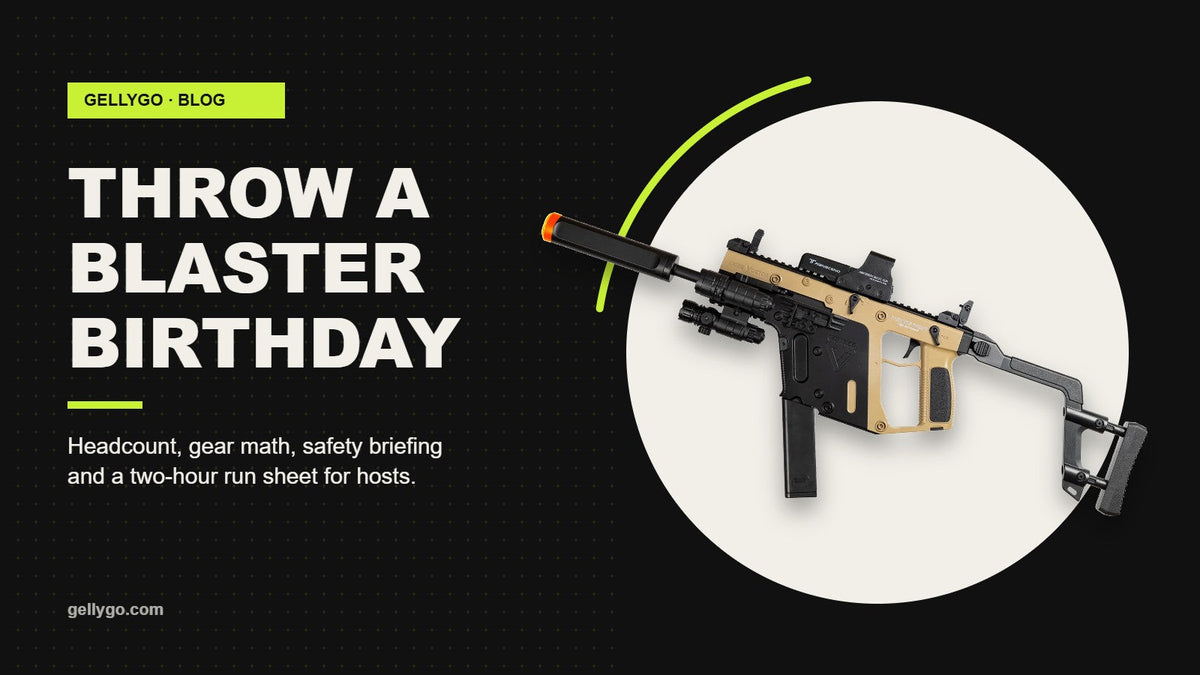
A gel blaster birthday sounds simple: hand out blasters, point everyone at the backyard, cut the cake. In practice, the parties that go well are the ones where an adult planned the boring parts — how many blasters, who referees, what happens when someone gets hit in the hand at close range and starts crying. The parties that go badly skipped that part.
This is the host's playbook: headcount, gear math, a two-hour run sheet, the safety briefing, and the stuff you'll want to have sorted before the first guest arrives.
Two weeks out: the decisions that shape everything
- Pick an age band and stick to it. A 9-year-old and a 15-year-old don't play the same game. If the guest list spans a wide range, plan separate rounds by age rather than one big free-for-all. Check the age rating on every blaster you plan to hand out.
- Cap the headcount. 8–12 players is the sweet spot for an average backyard. Past that, you need a second referee and more cover, or games turn into a crowd standing in the open.
- Tell the other parents exactly what the party is. Put "gel blaster party" in the invite, say that eye protection is provided and required, and give them a way to say no. Some families won't be comfortable with realistic-looking blasters, and it's better to know before the day.
- Check your space and your neighbors. You need a yard with a clear back boundary — a fence, wall or hedge, not a street or a neighbor's patio. Give the neighbors a heads-up. Local rules on replica blasters differ by state and city, so confirm what applies where you live; our safety rules and US laws guide is a starting point, not a substitute for checking locally.
- Find your second adult. One adult runs games, one handles everything else (gear table, snacks, the kid who needs a break). Don't try to do both.
The gear math
Most hosts underestimate how much they need. Kids don't share blasters well mid-game, and nobody plays without goggles. Here's what to plan for a group of 10.
| Item | How many | Why |
|---|---|---|
| Sealed goggles | One per player + 2 spares | Someone always forgets theirs or fogs up. Spectators near the field wear them too |
| Blasters | One per active player | If you can't cover everyone, run rotating squads instead of sharing mid-round |
| Charged batteries | One per blaster + a few spares | Charge the night before. Never leave LiPos charging unattended during the party |
| Soaked gels | More than you think | Kids hold the trigger down. Soak the night before so they're full size by start time |
| Cover | At least one piece per two players | Folding tables on their side, big cardboard boxes, pop-up tents. No cover = no tactics = bored kids |
| Team markers | Two colors, one per player | Cheap pinnies or colored armbands end the "you're on my team!" arguments |
For party blasters, compact and lightweight beats realistic and heavy. A small SMG like the Vector-style blaster is easy for smaller hands to hold and aim, and quick to swap between players during rotations. For ammo, buy in bulk — our milky hardened gels come in a big enough pack to soak generously for a whole party. Follow the soaking guide so they're firm enough to feed reliably.
On goggles: sunglasses and open-sided safety glasses are not enough. Our eye protection guide covers what to look for.
The 5-minute safety briefing (read it out loud)
Do this before anyone touches a blaster, with every player standing in front of you. Keep it short, make them repeat the goggle rule back, and enforce it from the first minute — the first time you let something slide, the rule is gone.
- Goggles on before you enter the field. Goggles stay on until you leave it. Breaking this ends your round.
- No shooting at faces or heads. Aim center mass.
- Minimum distance. Pick one (10 feet is a common house rule) and say it clearly. Closer than that, call "bang, you're out" instead of shooting.
- No shooting at people who aren't playing — spectators, pets, the house, cars, the neighbor's yard.
- Hit means out. Raise your hand, walk to the respawn spot. No arguing with the ref.
- "Stop" means stop. When the ref shouts it, everyone stops firing and points blasters at the ground.
- Blasters stay in the field. Nobody takes one out front, into the street, or into the house.
A two-hour run sheet that works
| Time | What happens |
|---|---|
| 0:00–0:15 | Arrivals, name tags, goggles fitted. Hand out team colors |
| 0:15–0:30 | Safety briefing, then target practice. Everyone gets a mag at a target before shooting at people |
| 0:30–1:00 | Round 1: simple team elimination, short rounds (5–7 minutes) |
| 1:00–1:20 | Break: water, snacks, cake. Batteries swapped, mags refilled by the adult on gear duty |
| 1:20–1:50 | Round 2: objective game — capture the flag or protect the birthday kid |
| 1:50–2:00 | Final showdown, gear check-in, goodbyes |
The target practice slot is the one hosts skip and regret. It gets the first-time players comfortable with the trigger, burns off the "can I shoot now?" energy, and lets you spot any blaster that's jamming before it matters. A steel plate like our rotatable IDPA steel target is a crowd-pleaser here — kids love the ping — and it doubles as a mini-competition station during the break.
Keep rounds short. Ten minutes feels like forever to a kid who got tagged in the first thirty seconds. For more formats with full rules, see our 7 game modes for groups. A birthday-specific favorite: Protect the VIP, where the birthday kid is the VIP and their team has to escort them to the far side of the yard.
Refereeing: what actually goes wrong
- "I didn't feel it." Gel hits are light, and kids honestly miss them. Make the ref's call final and move on fast.
- Point-blank shots. The most common cause of tears. Enforce the minimum distance hard in round one and it mostly stops.
- The kid who isn't having fun. Give them a job — timekeeper, flag guard, assistant ref. Never force anyone back into a round.
- Goggles creeping up. Fogged goggles get pushed onto foreheads. Pause the game, let them wipe, then restart. Don't let it slide.
- A blaster stops working. Have a spare ready and swap immediately. Fix it later with the won't-shoot diagnostic — not in the middle of the party.
After the last guest leaves
Pull every battery and store them safely, empty every magazine, and count the blasters back in. Leftover soaked gels go in the trash, not the drain. Spent gels in the grass shrink back over the following days, but do a sweep of patios and play areas first, especially if you have a dog. Our yard cleanup guide covers pets, drains and neighbors in detail.
Do the planning, run the briefing like you mean it, and keep the rounds short. That's most of the difference between the party kids talk about for a year and the one that ends early.
Kit out the party
Compact SMGs are light, easy to aim and quick to pass between players during rotations.
Shop SMGs & PDWs